
Reading Damage Before Writing Scope
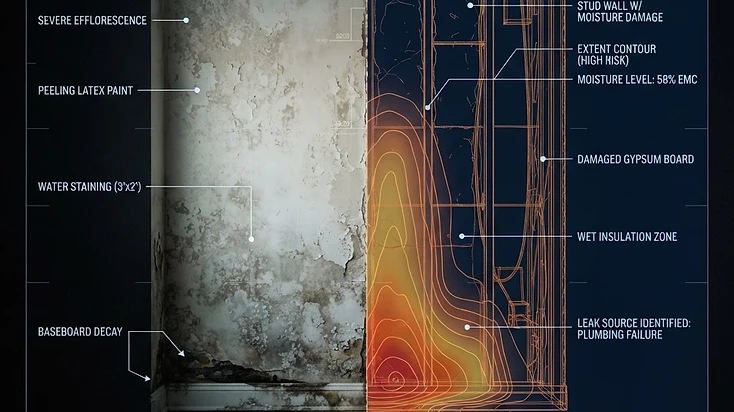
Scope written before the damage is understood becomes an argument. Reading the damage first turns scope into documentation.
Damage has a story. It has a cause, a path, an extent, and a relationship to every system it touched. Scope written before that story is understood is not a scope—it is a guess, and guesses become arguments.
The first question is never how much will it cost to fix? The first question is what actually happened here? A stain on a ceiling is a symptom. The cause may be a roof breach, a plumbing failure, a condensation line, or a combination that traveled through assemblies before presenting at the finish. The visible damage is often the smallest part of the loss; the hidden migration—through wall cavities, beneath flooring, into structural members—is where the real cost lives.
A proper damage read separates three things: cause (the originating event or condition), extent (how far it has progressed through the building systems), and interaction (what the moisture, heat, or impact affected beyond the obvious). Each requires its own method—visual, invasive where necessary, moisture mapping, and sometimes testing. Documented together, they form an evidence basis for scope.
Reading damage before writing scope also disciplines the scope itself. You stop pricing what isn't damaged. You stop under-scoping what is. And you give the owner, the carrier, and the contractor one shared picture of the loss instead of three competing interpretations—the point of the work.